Après quelques années d’expression figurative, Denis Zammit s’est tourné vers une approche plus abstraite de ses sujets. Ses thèmes, en écho avec la nature, sont déclinés dans diverses séries traitant du paysage, sa minéralité, le reflet et les mouvements de l’eau, ou encore le corps dans sa verticalité et son mystère. Il tente par cette exploration, de trouver un passage qui relie le monde extérieur, celui qui l’inspire, au monde intérieur celui qui l’anime et qui l’émeut. Comme une traversée. C’est le chemin entre ces deux espaces, si une frontière ou une rupture les séparent réellement, qu’il essaie de tracer et d’emprunter de toiles en toiles. Chacune d’elles venant ouvrir un regard tout à la fois particulier, mais également en lien avec une vision plus globale de la série créée. Face à la pluralité des diverses vies respectives que nous habitons, cette expérience se veut intime et de partage tout à la fois.
Techniquement, les pigments naturels, l’encre, la cendre, le brou de noix, la cire, le papier marouflé, l’acrylique sont les médiums qu’il utilise. Travaillés sur papier, sur toile ou sur bois pour les volumes. Il affectionne leur capacité à générer un dialogue entre geste contrôlé, intention et retour aléatoire. Ils cristallisent la continuité de son approche picturale, tournée vers le questionnement et l’émerveillement, de ce qui nous entoure et qui nous constitue.
« Dans un monde où les images sont consommées toujours plus et plus vite, la rencontre avec l’œuvre, ne peut avoir lieu que dans un retour au temps long. En se laissant imprégner par ce que l’on regarde. Dans une interaction sensitive avec les tableaux ou les sculptures qui s’offrent au regardeur. Une perception propre à chacune et à chacun, pour peut-être pénétrer et se découvrir dans l’un de ces paysages intérieurs. Miroirs de la nature, ils nous parlent de l’impermanence de ce qui est, de ce que l’on regarde, de ce que l’on vit. Une transformation perpétuelle et universelle. Apparaître, prendre corps, matière, texture et disparaître. Pour devenir autre. » Denis Zammit
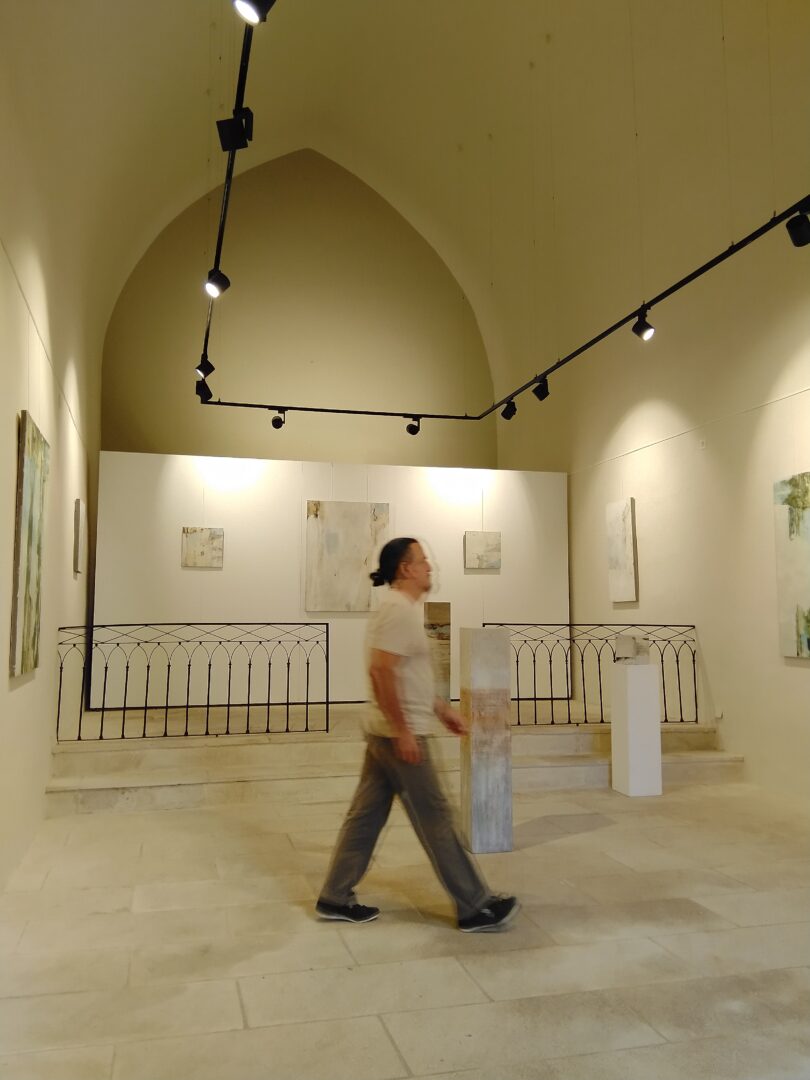
To find and unroll the thread which links us to nature and the place we occupy here, is what animates my creations. The tenuous thread where this poetry of nature, of our environment brings us back to the being, to a discussion between outside and inside. Contemplation is the core of my paintings. In my studio when I come back to the sensation of the fixed gaze I listen to a sort of harmony between what I put on the canvas or the volume and which is the response generated.
Inspired by the elements earth, air and water, mental landscapes take shape and open up new, more abstract spaces, reflections of our intimate sensations. The mediums I use such as walnut stain, ink, wax, pigments binding acrylic and oil, ash and paper allow a back and forth between controlled gesture and random appearance. Their interest lies in their capacity of interaction, mixing, dispersion and erasure.
Between intimate and universal trying to find a path which allowed us to create his own path of painting.